For this sustainable design case study, we interviewed designer Steven Cretney, based in BC. If you’d like to have your sustainable work featured, please fill out our case study Q&A.
What was the main goal of this project and the design objective toward that goal?
The goal of the project was to increase awareness and use of library services among people who may not have felt the Library was relevant, accessible, or intended for them. This included addressing outdated perceptions, gaps in awareness, and practical barriers to access, particularly for young adults, racialized and newcomer communities, and rural residents.
Developed for the Nelson Public Library, which serves a small city of roughly 11,000 people and a much larger, mostly mountainous rural region, the campaign needed to be inclusive, accessible, and adaptable to diverse and changing community needs.
I led the communications strategy and campaign planning, developing the core concept, messaging, writing, creative direction, and design. The objective was to create a flexible campaign system that could spark curiosity, feel welcoming, and work effectively within a tight budget.
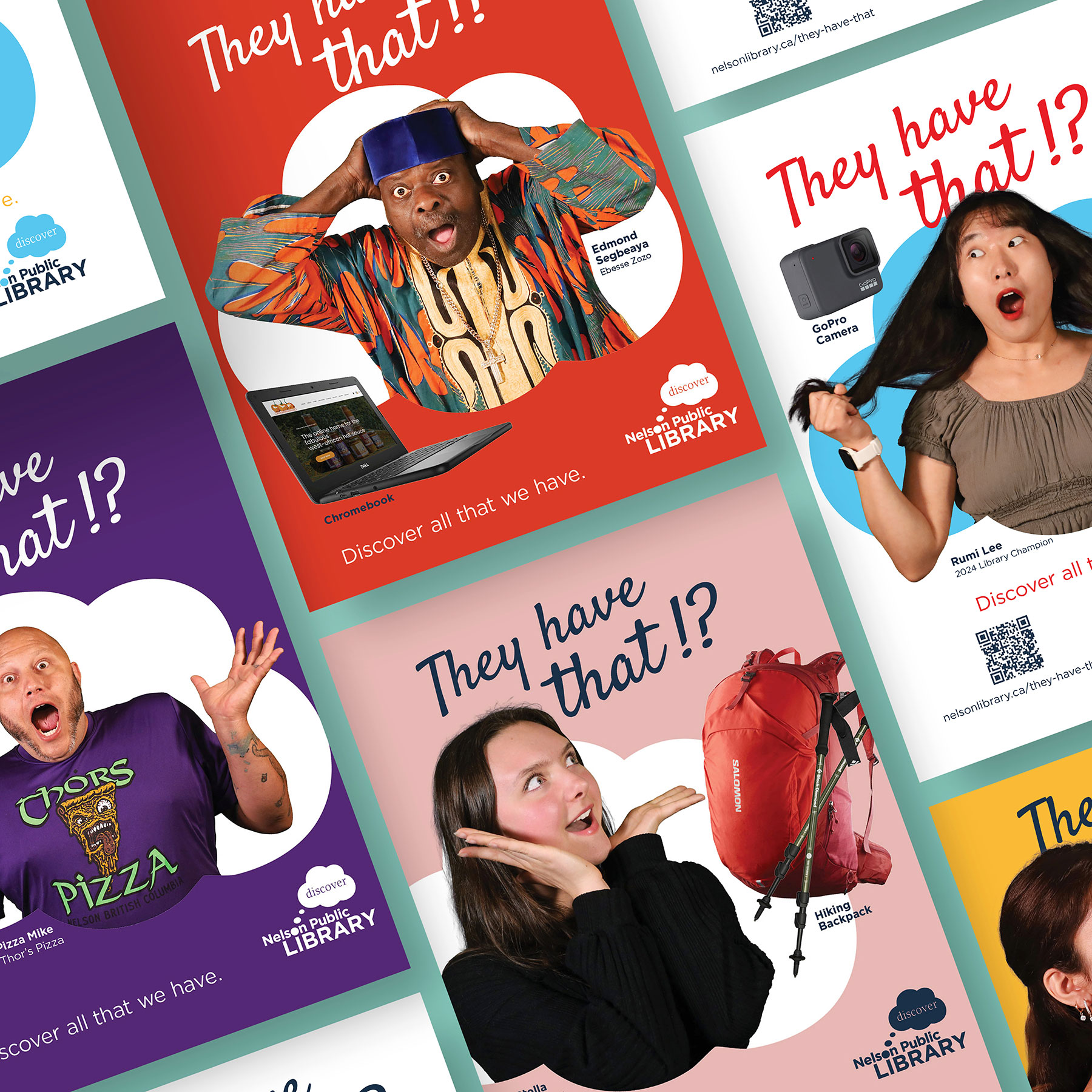
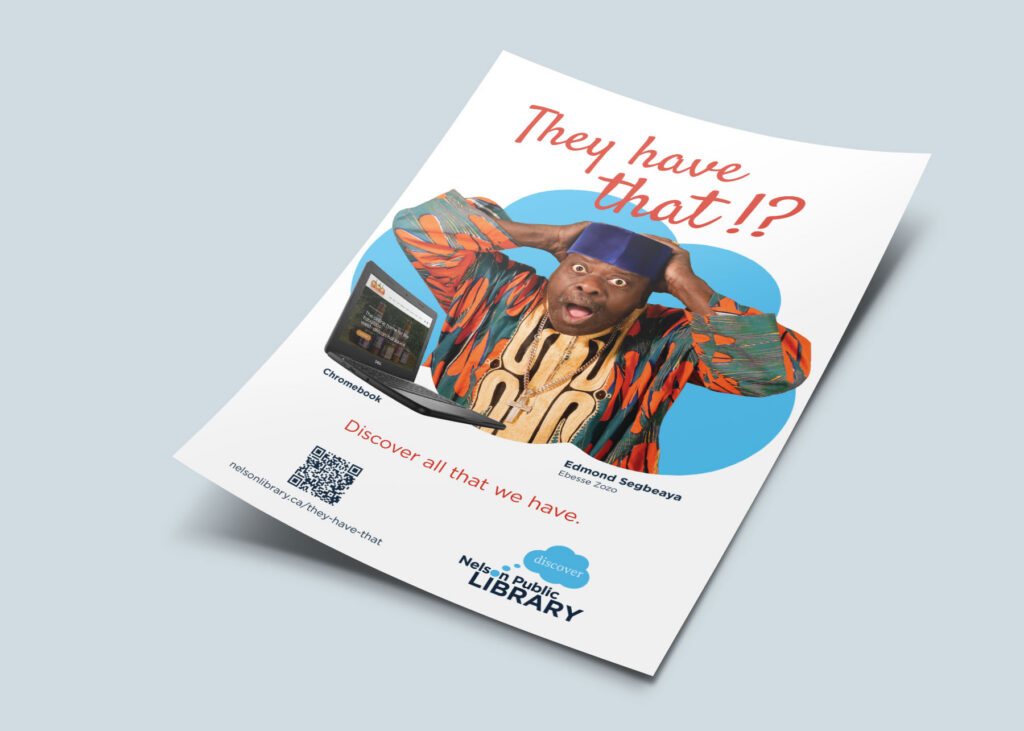
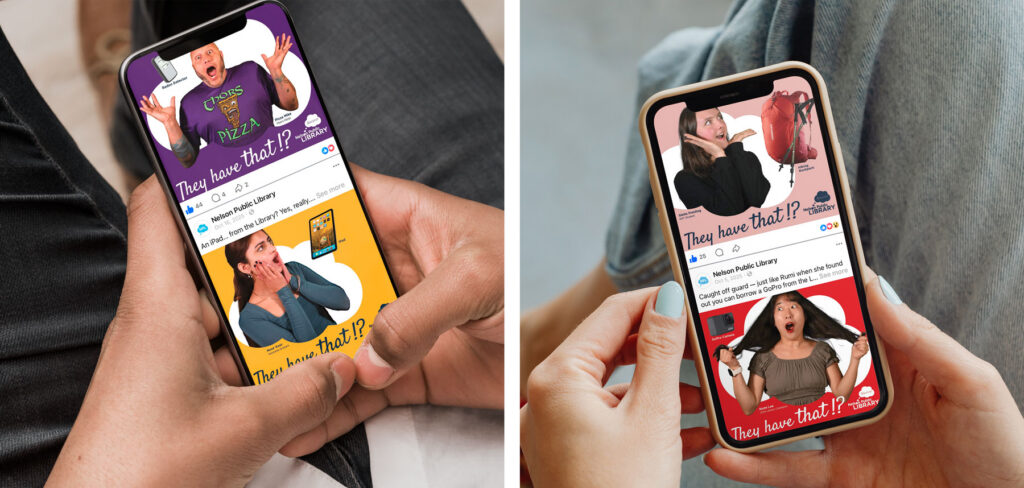
The campaign was structured around three complementary messaging pillars, with “They Have THAT!?” as the most visible and engaging expression:
- “They Have THAT!?”
Playful, curiosity-driven messaging that highlights surprising and unexpected things you can borrow from the Library, from ukuleles and GoPros to radon detectors, pressure canners, and thermal cameras. - “It’s Free with Your Card”
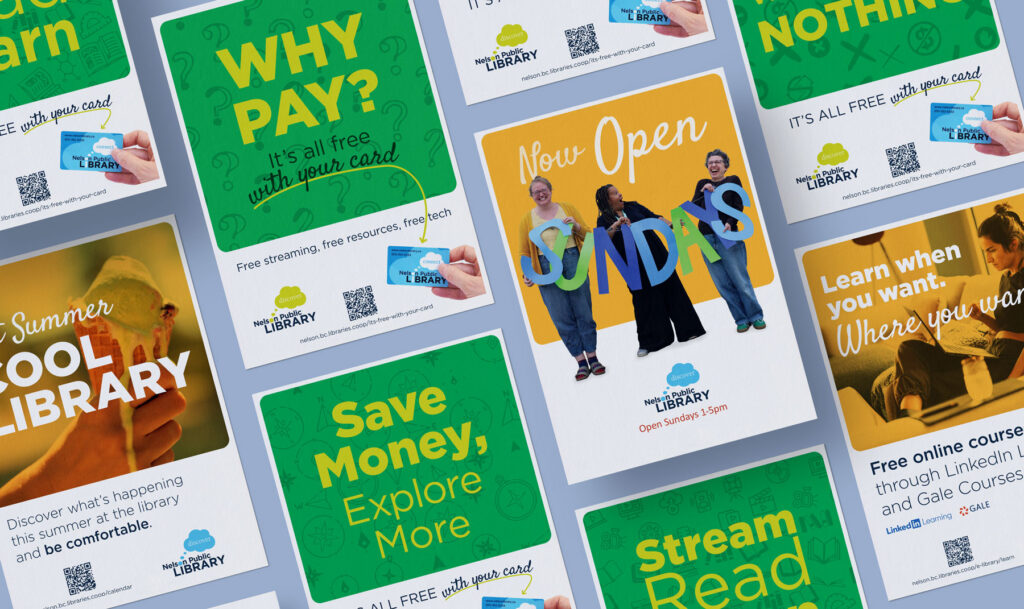
Reassuring messages that emphasize value, affordability, and free access to services and resources. - “At Your Convenience”
Friendly, practical reminders about Sunday hours, online services, and remote pick-up options that make Library services easier to access.
All visuals used the Library’s existing brand, with accessibility built in through strong contrast, legible typography, and clear layouts.
A key secondary goal was to create a campaign that could be sustained in-house. Adaptable templates, clear documentation, and skill-sharing enabled staff to continue producing and updating materials, extending the campaign’s impact while minimizing cost and waste.
What sustainability opportunities did you see?
I saw an opportunity to design something that would last. Rather than creating one-off materials, the focus was on building tools, confidence, and skills so the Library could keep the campaign going on its own.
There was also a chance to make sustainability feel natural and human by using real community voices, existing spaces and equipment, local suppliers, and reusable design systems. The campaign reflects the Library’s culture of sharing and reuse, not just in the message, but in how the work was done.
Did your client come to you with sustainability requirements? If not, how did you encourage and/or support your client to make more sustainable choices?
The Library did not request any specific sustainability requirements, but my commitment to sustainability principles was central to why they chose to work with me. They were familiar with my community involvement and values around equity, climate action, and long-term impact, and trusted that those principles would guide the work.
That trust made it possible to embed sustainability throughout the project, from inclusive representation and accessible design to capacity-building and long-term use of the materials.
“For us, sustainability means creating lasting impact socially, culturally, and economically. This campaign reflects that by building strong community connections and creating engagement strategies that can grow and adapt over time.”
Tracey Therrien, Chief Librarian
What sustainable choices did you make and/or advocate for?
Sustainability was intentionally integrated into both the campaign structure and the day-to-day design decisions. Rather than treating sustainability as a single feature, the work was shaped around a three-theme framework that addressed different barriers to access while supporting long-term value.
From a sustainability lens, this approach allowed the campaign to support all four sustainability pillars:
- Social sustainability:
Each theme addressed a different barrier to access, from awareness and affordability to convenience and confidence. By featuring recognizable community members of different ages, cultures, and lived experiences, the campaign helped more people see themselves reflected in the Library and feel welcome engaging with its services. - Cultural sustainability:
The campaign was grounded in local stories and shared community values. Featuring well-known community members and maintaining a consistent tone, voice, and visual language across all three themes helped reinforce trust, local identity, and the Library’s role as a cultural connector and gathering place over time. - Economic sustainability:
The campaign was designed as a reusable system, not a set of disposable ads. Adaptable templates, photography guidelines, and InDesign files enabled staff to continue producing materials in-house. Posters were designed for in-house printing to minimize ongoing costs, while larger print runs were handled by a local print shop, supporting the regional economy and reducing reliance on external vendors. - Environmental sustainability:
By promoting borrowing and sharing instead of buying, the campaign encouraged reduced consumption and normalizing reuse as an everyday, accessible action, positioning the Library as a practical, community-based climate solution. Photography and content creation relied on the Library’s existing media room, lighting, green screens, and equipment, reducing the need for rentals, travel, and additional resource use. Campaign assets were designed for long-term use, with adaptable templates and materials that could be reused and updated over time. When printing was required, waste was minimized through in-house production and local printing.
What challenges or barriers did you encounter in doing sustainable design, if any, and how did you overcome them?
In practice, budget constraints were a key consideration, particularly in terms of how many campaign materials could be created directly within the project scope. Rather than producing a large number of finished assets upfront, the focus shifted toward creating a smaller set of strong examples that could be expanded over time.
Photography and content creation made use of the Library’s existing media room, lighting, green screen, and equipment. I provided creative and photo direction, while student photographer Elliot Cretney took the photographs and supported staff in learning how to photograph additional community members themselves, including lighting and green screen setup. In tandem, adaptable design templates and clear, step-by-step guides in Photoshop and InDesign were created so staff could continue producing new materials independently.
This approach allowed the campaign to grow beyond the initial deliverables, making the work more sustainable, scalable, and resource-efficient over time.
“Learning to use the Tech Hub’s professional equipment and having ready-to-go design resources means we can confidently create new “They Have THAT!?” materials on our own. This has strengthened our long-term ability to communicate creatively and consistently with our community.”
Laura Harris, Assistant Chief Librarian
If you had a chance to do a project like this again with unlimited funds and time, what other sustainable design choices or tactics would you pursue?
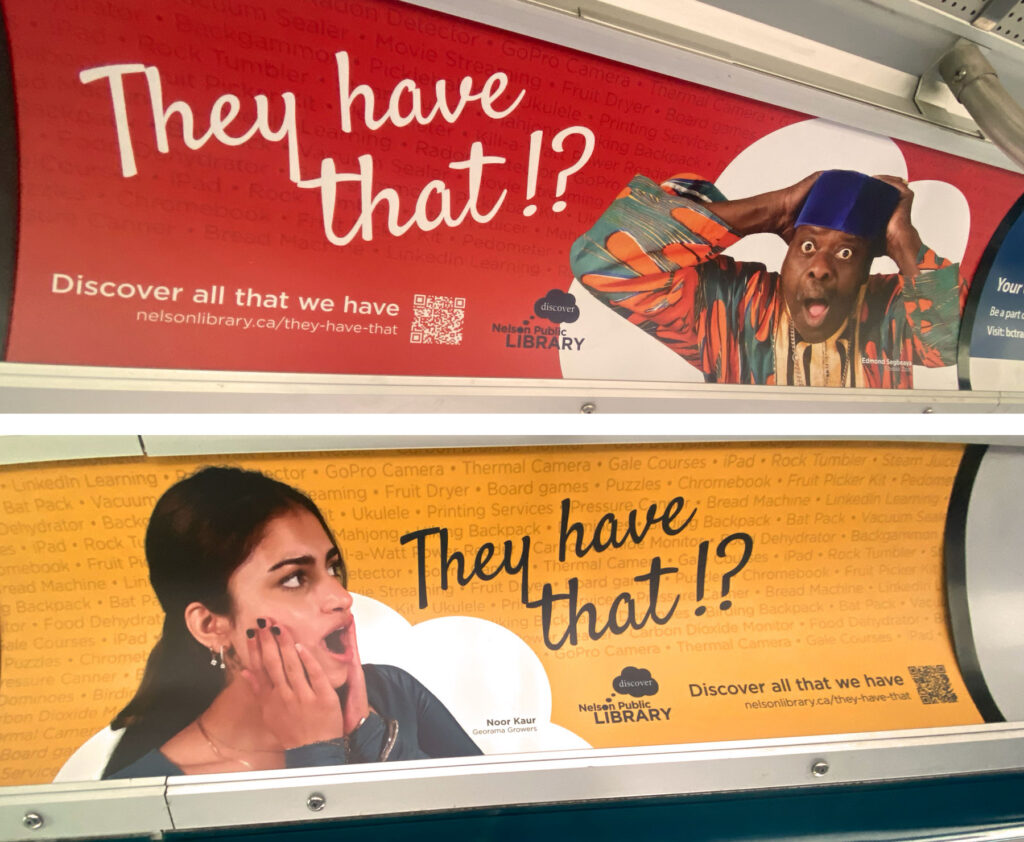
With more time and resources, I’d love to take the campaign even further. This could include bold exterior bus ads to complement interior transit ads, multilingual materials to better connect with newcomer communities, and community-led videos and radio stories that highlight local voices.
Enhancing the Library’s website would be another high-impact step, with clearer navigation, stronger search tools, and a more intuitive structure that makes exploring programs, resources, and events easier and more enjoyable. Building on the Library’s strong existing partnerships with local organizations and businesses would further embed it in the community and extend the campaign’s reach in meaningful ways.
There would also be opportunities to deepen the Library’s sustainability story by tracking and sharing the environmental and social benefits of borrowing instead of buying, and by continuing to design tools and systems that staff can reuse, adapt, and grow over time.
And if the Library ever decides to move ahead with these ideas, I might just know a designer who’d be happy to help.
What was the most insightful thing you learned practicing sustainable design on this project?
I have learned that working sustainably is energizing and genuinely fun.
Collaboration, creativity, mentorship, and problem-solving all thrived on this project. Empowering staff, sharing knowledge, and watching the campaign grow beyond its original scope made the work more meaningful and rewarding.
Were you able to measure any tangible impacts of your work? How did you do this?
Yes. Early results show clear signs of increased engagement:
- Library of Things checkouts increased by more than 34% over the first three months of the campaign, growing from an average of 35 items per week in September to 47 per week by November. This steady increase reflects growing awareness and comfort with borrowing non-traditional items, a key goal of the campaign.
- Nearly 400 people clicked through to the webpage in the first three months, with most visitors coming directly from social media ads — a strong signal that the campaign messaging sparked curiosity and action.
- New library memberships showed consistent month-over-month growth, reinforcing that the campaign was effectively converting awareness into action.
The Library also received strong qualitative feedback. One community member saw a bus ad featuring a laptop, realized technology could be borrowed, and came in to get a library card and check one out. Staff observed people stopping outside the building to photograph posters or scan QR codes, and social media comments regularly expressed surprise and delight.
“The ‘“They Have THAT!?” campaign helped us reach new audiences by showcasing the Library in a fresh, joyful way. It increased engagement and shifted perceptions of the Library as a vibrant, welcoming space.”
Tracey Therrien, Chief Librarian
Please share about why sustainable design is important to you…
Sustainable design means aligning creativity with responsibility. It embraces maximizing positive impact while reducing harm. It brings social, cultural, economic, and environmental values into strategy, process, and production.
As a designer, I have the opportunity to help address challenges like inequality, climate change, and community resilience. When practiced thoughtfully, sustainable design creates space for hope, action, and long-term value.
Any final thoughts or sustainability advice for designers, colleagues, clients, and design students?
I think that the most sustainable thing a designer can do is choose projects that create lasting, positive change. Using our creativity and energy for initiatives that reduce waste, support local, and help create an inclusive community where people see themselves reflected.
When sustainability is part of everyday practice, design becomes part of the solution.
Sustainability is not a checklist. It’s a mindset.
Learn more about how good design is sustainable design: descan.ca/pro-practice/sustainability
If you’d like to have your sustainable work featured, please fill out our case study Q&A.